
Water Filter O-Rings
EPDM and silicone seals for filter housings, RO systems and whole-house units. NSF-61 potable water grades.
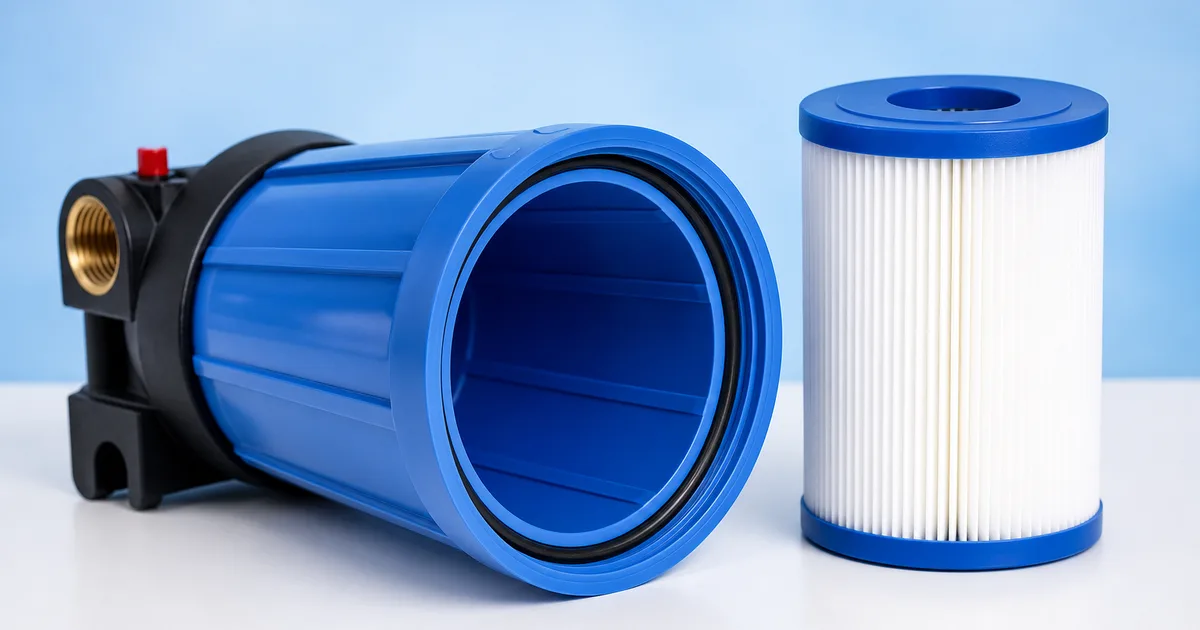
Water filtration systems rely on O-rings to seal filter housings, RO membrane vessels, and connection fittings. These seals must resist chlorinated municipal water, temperature cycling, and in some cases, the pressure fluctuations from water hammer. A leaking filter housing O-ring allows unfiltered water to bypass the cartridge, defeating the purpose of the filter and potentially contaminating the water supply. **Where O-Rings Seal in Water Filter Systems** **Filter housing sump-to-cap seal.** The most common failure point — the large O-ring that seals the filter housing sump (bottom) to the cap (top). This seal must survive the full water pressure, opening/closing during cartridge changes, and the weight of the water column. Standard whole-house filters operate at 1–8 bar municipal pressure. When this O-ring fails, water leaks from the housing joint, often spraying under pressure. **RO membrane housing.** Reverse osmosis systems use O-rings in the membrane housing end caps to seal the membrane element and prevent feed water from bypassing the membrane. These seals must resist the pressure differential across the membrane (typically 3–6 bar) and the concentrated brine on the reject side. **Fitting and adapter connections.** Filter systems use multiple O-ring-sealed fittings: inlet/outlet ports, bypass valves, pressure gauge ports, and adapter unions. These seals must survive pressure, temperature, and the torque from installation. **UV sterilizer unions.** UV water sterilizers use quartz sleeve seals and union O-rings. These seals must resist UV radiation (which degrades many elastomers), hot water from the UV lamp, and chlorine. VMQ silicone or high-grade EPDM is required. **Potable Water Compliance** All O-rings in drinking water systems must comply with potable water contact standards. NSF-61 (USA) and WRAS (UK) are the primary certifications. [EPDM](/products/epdm/) is the standard material — it is inert, does not impart taste or odor, and is widely NSF-61 certified. [VMQ silicone](/products/vmq/) is used in high-temp and food-grade applications. Black EPDM is the OEM standard; blue EPDM is often used to visually distinguish potable-water-grade seals from industrial grades.
Application Requirements
Recommended Materials
EPDM 70 Shore A (NSF-61)
The standard for all potable water filter housings, RO systems, and whole-house units. NSF-61 and WRAS certified grades available.
Temp: -50°C to +150°C
Black or blue EPDM is the industry standard. Blue color indicates potable-water grade in many facilities. Resists chlorine and chloramines. Use silicone grease only — no petroleum products.
VMQ (Silicone) 70 Shore A (FDA)
UV sterilizer seals, high-temp filter housings, and food-grade water systems. FDA 21 CFR §177.2600 compliant.
Temp: -60°C to +230°C
Resists UV radiation better than EPDM. More flexible for frequent cartridge changes. Lower abrasion resistance than EPDM. FDA grades for food-contact water systems.
FKM 75 Shore A
Industrial water treatment and chemical feed systems where EPDM may degrade. NOT for direct potable water without specific certification.
Temp: -20°C to +200°C
Overkill for residential water filters. Used in commercial chemical treatment systems. Verify NSF-61 certification if used for drinking water.
Design Tips
- 1.Use only silicone grease or food-safe lubricant on filter housing O-rings. Petroleum grease contaminates drinking water and attacks EPDM.
- 2.Replace the housing O-ring every time you change the filter cartridge — the seal takes compression set and will leak if reused.
- 3.Inspect the O-ring groove for grit and mineral deposits before installing a new seal — debris prevents proper seating and causes leaks.
- 4.For hard water areas, replace filter O-rings every 6 months — mineral buildup hardens the seal and causes leaks around the housing joint.
- 5.Hand-tighten plastic filter housings only — excessive torque with a wrench cracks the housing and crushes the O-ring.
- 6.For RO systems, replace membrane housing O-rings during every membrane change — the seal ages with the membrane.
- 7.Store spare O-rings in original packaging away from UV and ozone — EPDM degrades during storage if exposed to light and air.
- 8.Verify NSF-61 or WRAS certification before using any O-ring in a drinking water system — not all EPDM compounds are potable-water approved.
Common Sizes
| Size | Typical Use |
|---|---|
| Metric 55×3 mm | Small filter housings (2.5×5 inch, 2.5×10 inch) |
| Metric 65×3 mm | Standard filter housings (2.5×20 inch, Big Blue 10 inch) |
| Metric 75×3 mm | Large filter housings (Big Blue 20 inch) |
| Metric 85×3 mm | Whole-house filter housings (4.5×20 inch) |
| Metric 40×2.5 mm | RO membrane housing end cap seals |
| Metric 12×2 mm | Fitting and adapter connection seals |
| Metric 18×2.5 mm | UV sterilizer quartz sleeve seals |
Frequently Asked Questions
What O-ring material is best for water filters?
EPDM 70 Shore A with NSF-61 certification is the standard for all potable water filter housings and RO systems. It resists chlorine, chloramines, and hot water without leaching harmful substances. VMQ silicone is an alternative for UV sterilizers and high-temp applications. Never use NBR in drinking water systems without specific NSF approval — it may impart taste and odor and is not universally certified for potable water.
Why is my water filter housing leaking?
The most common cause is a worn or improperly seated housing O-ring. During filter changes, the O-ring can shift, twist, or fall out of the groove. Mineral deposits and grit prevent proper seating. Fix: remove the housing, clean the O-ring groove thoroughly, inspect the O-ring for cracks or compression set, replace with a new NSF-61 EPDM O-ring lubricated with silicone grease, and reinstall hand-tight only.
What size O-ring fits a Big Blue filter housing?
Big Blue 10-inch housings typically use a 65×3 mm EPDM O-ring. Big Blue 20-inch housings use a 75×3 mm O-ring. Standard 2.5-inch diameter housings (10-inch and 20-inch) use 55×3 mm and 65×3 mm respectively. Always measure the removed O-ring or check the manufacturer parts list — Pentair, Watts, and Culligan housings may use slightly different sizes.
Can I reuse a water filter O-ring?
No — always replace the housing O-ring when changing the filter cartridge. The O-ring takes compression set during service and will not seal reliably a second time. Reused O-rings are the leading cause of post-maintenance filter leaks. O-rings are inexpensive compared to water damage from a leaking filter housing.
How do I lubricate a water filter O-ring?
Use only silicone grease or a food-safe O-ring lubricant. Apply a thin film to the entire O-ring surface before installation. Silicone grease is compatible with EPDM and VMQ, is NSF-61 approved, and does not contaminate drinking water. Never use petroleum jelly, mineral oil, or WD-40 — these attack EPDM and contaminate the water supply.
Do you supply water filter O-ring kits?
Yes, we supply water filter O-ring kits containing the most common sizes for standard and Big Blue filter housings, RO membrane vessels, and UV sterilizer unions. Kits include NSF-61 EPDM O-rings in sizes from 12×2 mm to 85×3 mm. Custom kits for specific filter brands (Pentair, Watts, Culligan, Hydronix) are available on request. MOQ from 1 kit.
Need water filter O-rings?
We supply NSF-61 EPDM and silicone O-rings and kits for filter housings, RO systems and UV sterilizers. Standard and custom sizes. MOQ 1 piece.