
Vacuum O-Rings for KF, ISO-K & CF Flanges
Low-outgassing FKM, FFKM and VMQ seals for high, ultra-high and extreme-high vacuum systems. Material selection, surface finish, permeation data and installation best practices.
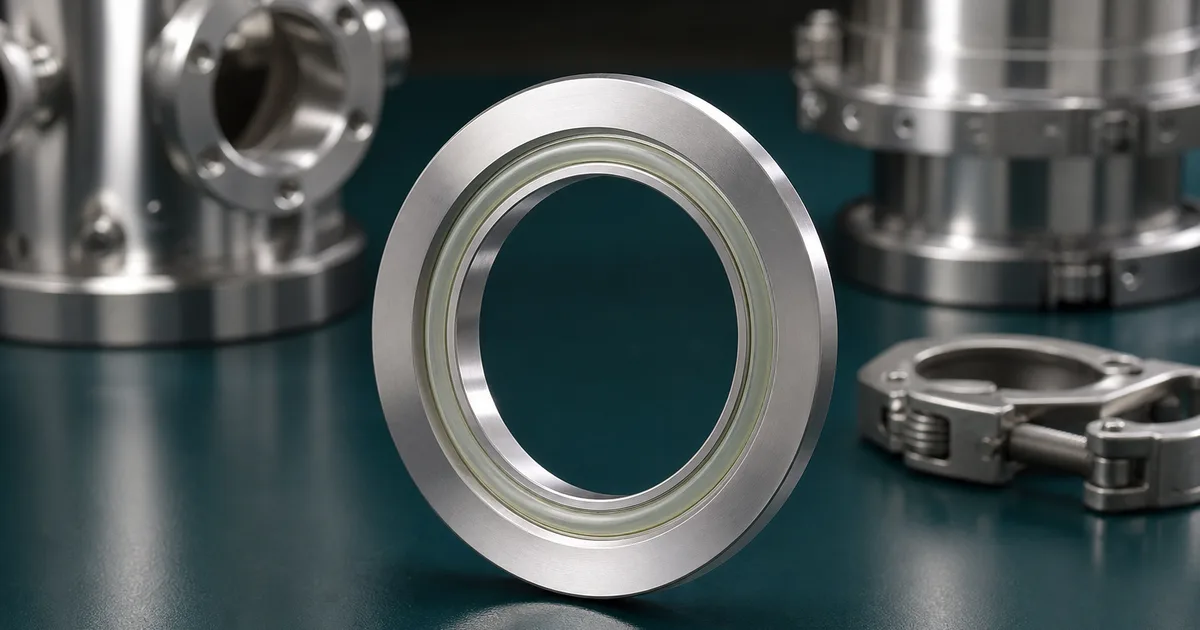
Vacuum sealing is one of the most demanding applications for O-rings. In a vacuum system, the seal is not just preventing leakage out-it is preventing every molecule of gas from leaking in. At 10^-9 torr, a single fingerprint left on a flange can outgas for hours, destroying the vacuum. At 10^-11 torr, even the bulk polymer of the O-ring becomes a gas source through permeation. This guide explains how to select, install, and maintain O-rings for high vacuum (HV), ultra-high vacuum (UHV), and extreme-high vacuum (XHV) systems, with specific guidance for KF, ISO-K, and CF flanges. **The Special Requirements of Vacuum Sealing** Vacuum systems impose three unique demands that do not exist in positive-pressure sealing: outgassing, permeation, and virtual leaks. **Outgassing** is the release of adsorbed and absorbed gases from the O-ring bulk and surface. Every elastomer absorbs atmospheric gases-nitrogen, oxygen, water vapor, carbon dioxide-during storage and installation. In a vacuum, these gases desorb and raise the chamber pressure. The rate of outgassing is measured in torr-L/(s-cm^2) and must be minimized for UHV and XHV. Solutions include: using low-outgassing materials like [FKM](/products/fkm/) and [FFKM](/products/ffkm/); baking the system under vacuum to drive off volatiles; and using metal seals (copper gaskets on CF flanges) for the most demanding applications. **Permeation** is the diffusion of gas molecules through the bulk of the elastomer. No polymer is truly impermeable-gas dissolves into the high-pressure side of the seal, diffuses through the polymer matrix, and desorbs from the low-pressure (vacuum) side. Permeation rate depends on material, thickness, temperature, and gas species. Helium permeates fastest through all elastomers; hydrogen is also highly mobile. For UHV below 10^-9 torr, the permeation rate of even the best elastomer may exceed the allowable leak rate, forcing the use of all-metal seals. **Virtual leaks** are trapped volumes between the O-ring and the groove that slowly outgas into the vacuum. A poorly designed groove with dead volumes, or an O-ring that does not fully fill the groove, creates pockets of trapped air that bleed into the chamber for hours or days. Proper groove design with vented grooves or full-fill geometry eliminates virtual leaks. **Material Selection for Vacuum Applications** The choice of O-ring material depends on the vacuum level, temperature, and chemical environment: **FKM (Viton) 75 Shore A.** FKM is the workhorse for general vacuum applications from rough vacuum down to about 10^-6 torr. It offers low outgassing, excellent chemical resistance, and good mechanical properties. Standard FKM is suitable for most laboratory vacuum systems, coating chambers, and industrial vacuum processes. FKM can be baked to 150 degrees C to accelerate outgassing before operation. For [semiconductor processing](/industries/semiconductor/), FKM is the standard for process gas lines and chamber seals where chemical resistance is required alongside moderate vacuum. **FFKM (Kalrez, Chemraz, Simriz).** FFKM is the ultimate elastomer for UHV below 10^-9 torr. Its fully fluorinated backbone provides the lowest outgassing and permeation rates of any elastomer, plus resistance to virtually all process chemicals. FFKM can be baked to 200-250 degrees C, further reducing outgassing. The trade-off is cost-FFKM is 10-50x more expensive than FKM. It is reserved for the most critical UHV and XHV applications: particle accelerators, space simulation chambers, semiconductor lithography, and molecular beam epitaxy systems. **VMQ (Silicone) 70 Shore A.** VMQ offers the lowest outgassing rate after baking of any standard elastomer and performs well at cryogenic temperatures down to -60 degrees C. It is an economical choice for low-vacuum and cryogenic vacuum applications where chemical resistance is not critical. However, VMQ has poor tear strength and is easily damaged during installation. It is also permeable to many gases. VMQ is commonly used in vacuum lines for biological samples, freeze-dryers, and low-temperature research systems. **EPDM.** EPDM is rarely used in vacuum systems because it absorbs water vapor aggressively and has high outgassing rates. It may be used in specific applications where water vapor is not a concern and compatibility with process fluids requires it. **KF / ISO-K / CF Flange O-Ring Sealing** Vacuum flanges use three main standards, each with different sealing approaches: **KF (Kleinflansch / NW) flanges** are used for small-bore tubing from NW-10 to NW-50. The seal is an elastomer O-ring seated in a centring ring (aluminum or POM) that fits between the two flanges. The flanges are clamped together with a hinged clamp or wing nut. KF flange O-rings are typically FKM or VMQ, with FFKM for demanding applications. The centring ring holds the O-ring in the correct position and prevents it from rolling during clamping. KF flanges are rated to about 10^-8 torr with proper O-ring selection. **ISO-K flanges** are used for medium and large bore from ISO-63 to ISO-250 and above. Like KF, they use an elastomer O-ring in a centring ring, but with bolted clamping chains instead of hinged clamps. ISO-K O-rings are larger and must be more precisely sized to prevent extrusion under atmospheric pressure loading. FKM is standard; FFKM is used for UHV large-bore applications. **CF (ConFlat) flanges** are the standard for UHV and XHV. CF flanges do not use elastomer O-rings-they use copper gaskets that are crushed between knife-edge seals on the flange faces. CF flanges can achieve 10^-11 torr and below. However, many vacuum systems use CF for critical chamber seals and KF/ISO-K with elastomer O-rings for accessory ports, feedthroughs, and roughing lines. In these hybrid systems, the elastomer O-ring seals must be selected with the same care as the CF seals, as they determine the base pressure of the accessory line. **Surface Finish and Vacuum Grease** Surface preparation is as important as material selection in vacuum sealing: **Flange surface finish.** For elastomer-sealed flanges (KF, ISO-K), a surface finish of 0.8-1.6 um Ra is adequate. The surface must be free of scratches, burrs, and machining marks that could damage the O-ring or create leak paths. For CF flanges with copper gaskets, the knife edge must be pristine-any damage requires re-machining or replacement of the flange. **O-ring groove design.** Vacuum O-ring grooves should be designed for 20-25% compression to maximize sealing force against atmospheric pressure. Groove fill should be 85-95% to minimize virtual leaks. Vented grooves with small passages to the vacuum side allow trapped air to escape rather than being compressed into a virtual leak. **Vacuum grease.** A thin film of vacuum-grade fluorinated grease on the O-ring reduces installation damage, improves initial sealing, and fills microscopic surface imperfections. Use only high-vacuum grease that has been vacuum-baked and certified for the target vacuum level. Common brands include Apiezon, Krytox, and Fomblin. Apply a very thin film-excess grease becomes an outgassing source. Never use standard petroleum grease in a vacuum system. **Selection Recommendations by Vacuum Level** | Vacuum Level | Pressure Range | Recommended Seal | Notes | |---|---|---|---| | Rough vacuum | 760-10^-3 torr | NBR, FKM, VMQ | Standard industrial vacuum | | High vacuum (HV) | 10^-3-10^-7 torr | FKM, VMQ | Laboratory and coating systems | | Ultra-high vacuum (UHV) | 10^-7-10^-11 torr | FFKM, metal (CF) | FFKM for elastomer ports; CF copper for chamber | | Extreme-high vacuum (XHV) | <10^-11 torr | Metal only (CF) | No elastomers; all-metal sealing required | For systems that must reach UHV but have elastomer-sealed ports, specify FFKM and plan for extended bake-out at 150-200 degrees C before achieving base pressure. The bake-out drives volatile species from the elastomer and reduces outgassing by orders of magnitude.
Application Requirements
Recommended Materials
FKM (Viton) 75 Shore A
General vacuum from rough vacuum to high vacuum (~10^-6 torr). Laboratory chambers, coating systems, and industrial vacuum lines where chemical resistance to process gases is required.
Temp: -20 degrees C to +200 degrees C
Standard choice for most vacuum applications. Bake to 150 degrees C to reduce outgassing before operation. Not suitable for UHV below 10^-7 torr due to permeation.
FFKM (Kalrez / Chemraz / Simriz) 75 Shore A
Ultra-high vacuum below 10^-9 torr. Semiconductor lithography, particle accelerators, space simulation, molecular beam epitaxy, and any system where elastomer seals must coexist with UHV requirements.
Temp: -15 degrees C to +320 degrees C
Lowest outgassing and permeation of any elastomer. Can be baked to 200-250 degrees C. High cost justified by performance. Specify for critical UHV elastomer ports on otherwise all-metal systems.
VMQ (Silicone) 70 Shore A
Low-cost vacuum and cryogenic vacuum applications. Biological sample lines, freeze-dryers, and low-temperature research where chemical exposure is minimal.
Temp: -60 degrees C to +200 degrees C
Lowest outgassing after baking of standard elastomers. Poor tear strength-handle carefully during installation. Higher gas permeability than FKM. Not for aggressive chemical environments.
Design Tips
- 1.Bake new O-rings under vacuum at 150 degrees C for 24 hours before installation to drive off adsorbed volatiles. This reduces initial outgassing by 10-100x.
- 2.Never touch O-ring sealing surfaces with bare hands. Skin oils contain high-vapor-pressure hydrocarbons that outgas for days. Use powder-free nitrile gloves.
- 3.Inspect O-rings under magnification before installation. Any nick, cut, or embedded particle is a potential leak path in vacuum service.
- 4.Use vented groove designs that allow trapped air to escape to the vacuum side. Trapped volumes create virtual leaks that persist for hours or days.
- 5.Apply vacuum grease sparingly. A thin film is beneficial; excess grease outgasses and limits ultimate pressure.
- 6.Replace O-rings whenever a flange is opened. Reused O-rings take compression set and may not reseal reliably.
- 7.Store vacuum O-rings in sealed bags in a clean, dry environment. Dust and moisture on the seal surface become outgassing sources.
- 8.For UHV systems, minimize the number of elastomer-sealed joints. Every O-ring is a permeation source; fewer seals mean lower base pressure.
Common Sizes
| Size | Typical Use |
|---|---|
| KF-16 to KF-50 | Small bore vacuum tubing and fittings (NW-16 through NW-50) |
| ISO-K 63 to ISO-K 250 | Medium and large bore vacuum lines and chamber ports |
| AS568-210 to -226 | General-purpose O-rings used in custom vacuum fittings and adapter flanges |
Frequently Asked Questions
What is the best O-ring material for high vacuum?
For high vacuum (10^-3 to 10^-7 torr), FKM (Viton) is the standard choice. It offers low outgassing, good chemical resistance, and reliable sealing down to about 10^-6 torr. For ultra-high vacuum below 10^-9 torr, FFKM is required-its fully fluorinated backbone has the lowest permeation and outgassing rates of any elastomer. VMQ silicone is an economical alternative for low-vacuum and cryogenic applications but has higher permeation and poor tear strength. For extreme high vacuum below 10^-11 torr, no elastomer is suitable; all-metal CF flange seals with copper gaskets must be used.
Can I use a standard O-ring in a vacuum system?
Standard industrial O-rings can be used in rough vacuum applications (down to ~10^-3 torr) if they are clean and properly installed. However, for high vacuum and above, you should use O-rings specifically manufactured for vacuum service. Vacuum-grade O-rings are produced in cleaner environments, packaged to prevent contamination, and often pre-baked to reduce outgassing. Standard O-rings may contain mold-release residues, surface contaminants, and absorbed atmospheric gases that outgas excessively in vacuum. We supply vacuum-grade FKM, FFKM, and VMQ O-rings cleaned and packaged for immediate use in HV and UHV systems.
How does outgassing affect vacuum performance?
Outgassing is the release of gases trapped in and on the O-ring surface. In a vacuum, these gases raise the chamber pressure and limit how low the vacuum can go. For example, a contaminated O-ring might outgas at 10^-5 torr-L/s, which is negligible at rough vacuum but catastrophic at 10^-9 torr. Outgassing sources include: atmospheric gases absorbed during storage (N2, O2, H2O, CO2); mold-release agents from manufacturing; surface contamination from handling; and volatile plasticizers in the compound. Bake-out at 150 degrees C under vacuum drives off most volatiles. For UHV, specify low-outgassing FFKM and handle seals with powder-free gloves in a clean environment.
What is a virtual leak and how do I prevent it?
A virtual leak is a trapped pocket of gas that slowly bleeds into the vacuum chamber, creating a persistent pressure rise that looks like a real leak but cannot be found with a leak detector. Common causes are: unvented O-ring grooves that trap air when the flange is assembled; screw holes that are blind instead of through-drilled; and weld cavities or porous materials. To prevent virtual leaks: design O-ring grooves with small vent channels to the vacuum side; use through-drilled bolt holes instead of tapped blind holes; and ensure all welds are fully penetrating and free of porosity. If a virtual leak is suspected, pump the system to its base pressure, isolate the pump, and monitor the pressure rise. A true leak will rise linearly; a virtual leak will show an initial rapid rise followed by a slower, asymptotic approach to equilibrium as the trapped volume depletes.
Should I use vacuum grease on my O-rings?
Yes, a thin film of high-vacuum grease is beneficial for most elastomer-sealed vacuum joints. The grease lubricates the O-ring during installation, preventing nicks and cuts. It also improves initial sealing by filling microscopic surface imperfections and reducing permeation slightly. Use only vacuum-certified fluorinated grease (Krytox, Fomblin, or equivalent) that has been tested for outgassing at your target vacuum level. Apply the thinnest possible film-excess grease is an outgassing source. For UHV systems where every outgassing source matters, some engineers omit grease on FFKM seals, relying instead on the material's inherent lubricity and precise surface finish.
How often should vacuum O-rings be replaced?
Vacuum O-rings should be replaced every time a flange is opened for maintenance or modification. Reused O-rings have taken compression set and may not reseal reliably. Even if they appear intact, the act of compressing and releasing the seal changes its stress distribution and surface contact pattern. In continuous-operation systems, establish a preventive replacement schedule based on bake-out cycles-each thermal cycle accelerates aging. As a rule of thumb: FKM seals in laboratory systems last 2-3 years; FFKM seals in UHV systems last 3-5 years; VMQ seals may need annual replacement due to lower mechanical strength. Always keep spare O-rings in sealed, dated packaging and replace any seal that shows visible wear, compression set, or contamination.
What is the difference between KF and CF flanges?
KF (Kleinflansch) flanges use an elastomer O-ring in a centring ring, clamped together with hinged clamps. They are quick to assemble and disassemble, suitable for vacuum down to about 10^-8 torr, and used for small-bore tubing (NW-10 to NW-50). CF (ConFlat) flanges use a copper gasket crushed between knife-edge seals on the flange faces. They achieve UHV and XHV (10^-11 torr and below) but require bolting and are not reusable without replacing the copper gasket. CF flanges are used for chamber seals, critical ports, and anywhere elastomer outgassing or permeation is unacceptable. Many systems use a hybrid approach: CF for the main chamber and KF for accessory lines.
Can you supply O-rings for semiconductor vacuum systems?
Yes, we supply vacuum-grade FKM and FFKM O-rings specifically for semiconductor processing equipment. Our semiconductor-grade seals are manufactured in clean environments, double-bagged in nitrogen-purged packaging, and certified for low outgassing and metal-ion content. We stock common KF and ISO-K sizes and can produce custom sizes for proprietary chamber designs. For EUV lithography and other XHV processes, we supply FFKM seals that have been pre-baked and certified for permeation rates below 10^-10 torr-L/s. Material certificates, bake-out protocols, and traceability documentation are available on request.
Need vacuum O-rings?
We supply FKM, FFKM and VMQ vacuum-grade O-rings in KF, ISO-K and standard AS568 sizes. Clean-packaged for HV and UHV service. MOQ 1 piece.