
Propane & Gas O-Rings
NBR and HNBR seals for LPG tank valves, regulators, QCC1 fittings and gas grill connections.
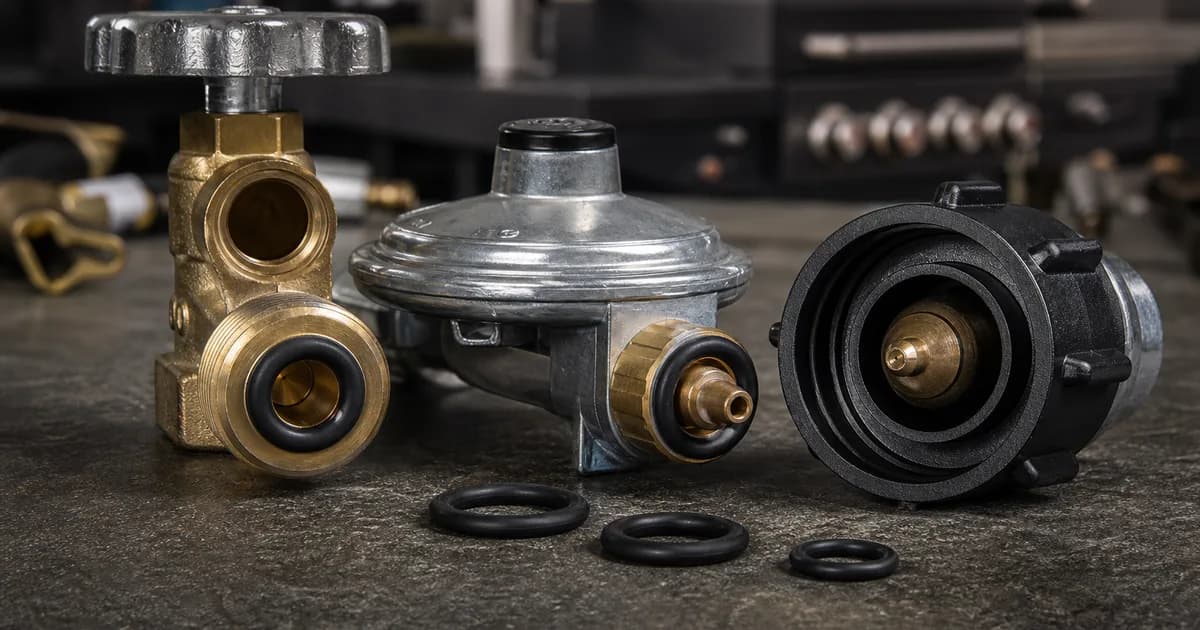
Propane and liquefied petroleum gas (LPG) systems use O-rings in tank valves, regulators, hose connections, and appliance fittings. These seals must resist hydrocarbon gas under pressure, survive outdoor UV and temperature cycling, and maintain safety-critical integrity — a leaking propane seal is not just a nuisance, it is a fire and explosion hazard. **Where O-Rings Seal in Propane and Gas Systems** **Tank valve (POL and QCC1 connections).** Propane tank valves use O-rings at the outlet connection where the regulator or hose attaches. The POL (Prest-O-Lite) connection uses a left-hand thread with an O-ring face seal. The newer QCC1 (Type 1) connection uses an internal O-ring that seals when the coupler is tightened. These seals must survive the full tank pressure (up to 15 bar at +50°C) and the torque from repeated tank changes. **Regulator inlet and outlet.** The regulator uses O-rings at both the tank connection (inlet) and the low-pressure hose connection (outlet). The inlet seal faces high-pressure liquid propane; the outlet seal faces low-pressure vapor (0.05–0.5 bar). Both must resist propane permeation and remain flexible across temperature extremes. **Hose and appliance fittings.** Propane hoses use O-ring seals at the crimp fittings and quick-connect adapters. Gas grills, patio heaters, and RV appliances use O-rings in the burner valves, orifices, and pilot light fittings. These seals must survive outdoor UV, rain, and temperature cycling from -40°C winter storage to +50°C summer sun exposure. **Safety Requirements** Propane is heavier than air and pools in low areas, creating explosion risk. A leaking O-ring can release propane without obvious odor (ethyl mercaptan odorant may not be detectable in small leaks). All propane system O-rings must be replaced at the first sign of leakage, discoloration, or physical damage. Never use standard Buna-N in propane systems without verifying compound compatibility — some NBR compounds swell excessively in propane. [NBR 70–90 Shore A](/products/nbr/) is the standard for most propane applications — it resists aliphatic hydrocarbons and maintains flexibility across the temperature range. [HNBR 80 Shore A](/products/hnbr/) is specified for high-pressure regulators and commercial applications requiring longer service life. [FKM](/products/fkm/) is overkill for propane but may be specified for extreme-temperature applications.
Application Requirements
Recommended Materials
NBR 70–90 Shore A
Standard for residential propane tanks, regulators, grills, and patio heaters. Resists LPG and maintains flexibility across temperature range.
Temp: -40°C to +120°C
70 Shore A for low-pressure fittings and hoses. 90 Shore A for high-pressure tank valves and regulators. Verify compound compatibility — some NBR grades swell >25% in propane.
HNBR 80 Shore A
Commercial regulators, high-pressure tank valves, and applications requiring longer service life or ozone resistance.
Temp: -40°C to +150°C
Superior to NBR for outdoor UV and ozone exposure. Better compression set resistance for long-term sealing. 2–3× NBR cost.
FKM 75 Shore A
Extreme-temperature applications near burners or in commercial high-pressure systems. Overkill for most residential use.
Temp: -20°C to +200°C
Not required for standard propane. Used in industrial gas systems and high-heat appliance connections. 5× NBR cost.
Design Tips
- 1.Inspect propane tank valve O-rings before every tank change — look for cracks, flattening, or hardening. Replace if any damage is visible.
- 2.Use a propane leak detector solution (soapy water) on all connections after installing a new tank — bubbles indicate a leak that must be fixed before use.
- 3.Never use petroleum grease on propane O-rings — use a propane-compatible lubricant or clean silicone grease.
- 4.Replace all O-rings in a regulator every 2–3 years or at first sign of leakage — regulator seals degrade with age and UV exposure.
- 5.Store propane tanks and spare O-rings away from direct sunlight — UV hardens rubber seals and reduces service life.
- 6.Do not overtighten plastic regulator fittings — excessive torque cracks the housing and crushes the O-ring.
- 7.For RV and marine propane systems, inspect O-rings before every trip — vibration and temperature cycling accelerate seal degradation.
- 8.If you smell gas (rotten egg odor), shut off the tank valve immediately, ventilate the area, and replace all O-rings before reuse.
Common Sizes
| Size | Typical Use |
|---|---|
| Metric 8×1.5 mm | Small regulator inlet seals, grill valve seals |
| Metric 10×2 mm | Standard regulator inlet and outlet seals |
| Metric 12×2 mm | QCC1 tank valve internal seal, large regulator seals |
| Metric 14×2.5 mm | POL tank valve face seal, large appliance fittings |
| Metric 16×2.5 mm | Commercial regulator and high-pressure tank seals |
| Metric 6×1.5 mm | Pilot light and small orifice seals |
| Metric 18×2.5 mm | Large commercial tank valve and manifold seals |
Frequently Asked Questions
What O-ring material is best for propane?
NBR 70–90 Shore A is the standard for most propane applications — it resists LPG, butane, and natural gas while maintaining flexibility from -40°C to +120°C. HNBR 80 Shore A is the upgrade for commercial regulators and outdoor applications requiring longer life and UV resistance. FKM is overkill for residential propane but may be used in industrial high-heat applications. Never use EPDM or silicone in propane — they are attacked by hydrocarbon gas.
Why does my propane tank leak at the regulator connection?
The most common cause is a worn or damaged O-ring at the tank valve or regulator inlet. The O-ring takes compression set from repeated tank changes and hardens over time. Fix: close the tank valve, disconnect the regulator, inspect the O-ring for cracks or flattening, replace with a new NBR O-ring, lubricate with propane-compatible grease, and reconnect. Test with soapy water before use.
Can I use silicone O-rings for propane?
No. Silicone (VMQ) has poor resistance to hydrocarbon gases like propane and butane. Propane causes silicone to swell and lose sealing force. NBR or HNBR are the correct materials for all propane and LPG seals. EPDM is also unsuitable — it swells in propane.
How often should propane O-rings be replaced?
Replace tank valve O-rings every 12 months or at every tank change if damage is visible. Replace regulator O-rings every 2–3 years. Replace grill and appliance O-rings every 2 years or at first sign of leakage. In commercial applications with daily use, replace annually. Always replace O-rings after any propane leak incident.
What size O-ring fits a QCC1 propane tank valve?
QCC1 (Type 1) propane tank valves typically use an internal 12×2 mm NBR O-ring. Some models use 10×2 mm or 14×2.5 mm. POL (Prest-O-Lite) tank valves use a face-seal O-ring, typically 14×2.5 mm. Always measure the removed O-ring or check the manufacturer specification — using the wrong size creates a dangerous leak.
Do you supply propane O-ring kits?
Yes, we supply propane and gas O-ring kits containing NBR and HNBR seals for tank valves, regulators, grills, patio heaters, and RV appliances. Kits include common sizes from 6×1.5 mm to 18×2.5 mm. Custom kits for specific brands (Weber, Char-Broil, Mr. Heater, Camco) are available on request. All seals are propane-compatible and tested for LPG resistance. MOQ from 1 kit.
Need propane and gas O-rings?
We supply NBR and HNBR O-rings and kits for propane tanks, regulators, grills and gas appliances. LPG-tested compounds. MOQ 1 piece.