
Pool & Spa O-Rings
EPDM and silicone seals for pumps, filters, chlorinators and hot tubs. Chlorine-resistant, hot-water-rated.
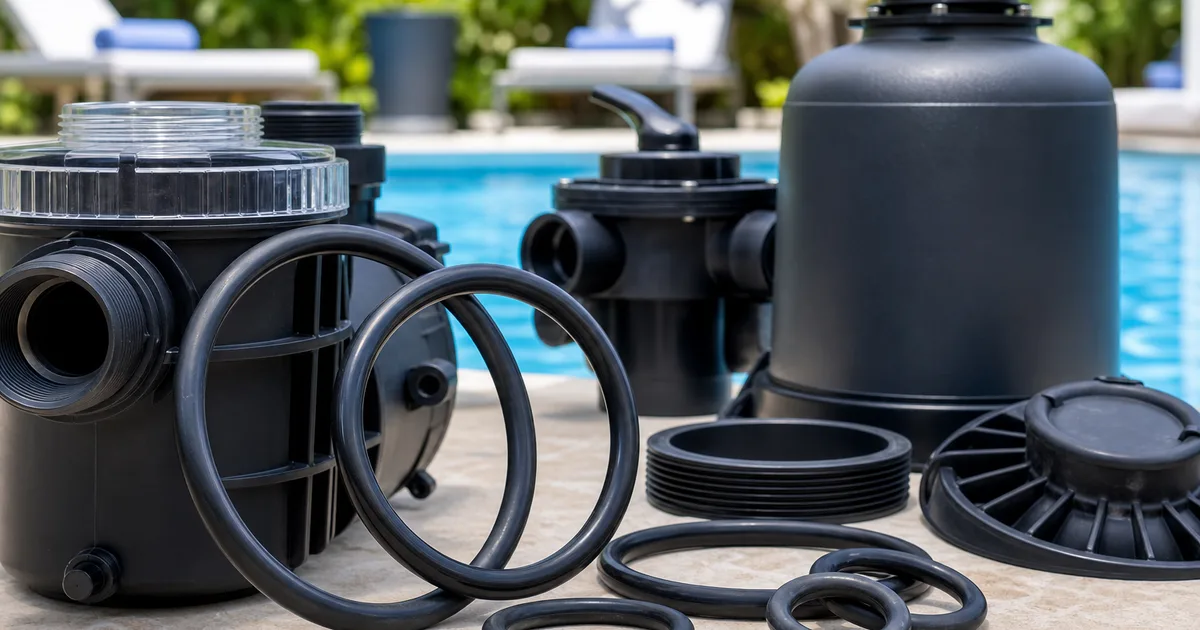
Pool and spa systems are surprisingly aggressive sealing environments. Continuous chlorine or bromine exposure, UV radiation, temperature cycling from ambient to +40°C, and seasonal shutdowns create conditions that rapidly degrade standard elastomers. A leaking pool pump O-ring wastes water, reduces filter pressure, and can damage the pump motor. A failed chlorinator seal allows chlorine gas to escape, creating a health hazard. **Where O-Rings Seal in Pool and Spa Systems** **Pump lid and pump basket.** The pump lid seals against the pump housing with a large-diameter O-ring. This seal must survive daily pump cycling (pressure on/off), chlorine vapor exposure, and UV if the pump is outdoors. The pump basket also uses an O-ring where it seats in the housing. When the pump lid O-ring fails, air is drawn into the system, causing the pump to lose prime and run dry — a leading cause of pump motor burnout. **Sand filter multiport valve.** The multiport valve (backwash, rinse, filter, waste) on sand filters uses multiple O-rings around the rotor and valve body. These seals must survive chlorine, operate under vacuum and pressure, and tolerate the grit and sand that inevitably enters the valve during backwash. A leaking multiport valve O-ring allows water to bypass the filter or leak to waste. **Chlorinator and salt cell.** Chlorinators (tablet feeders) and salt chlorine generators use O-rings to seal the lid and internal components. These seals face the highest chlorine concentration in the entire system — concentrated chlorine tablets or high-concentration electrolyzed chlorine. Standard NBR hardens and cracks within weeks in this environment. **Hot tub jets and valves.** Hot tub jets, air controls, and diverter valves use O-rings that must survive hot water (+38°C to +40°C continuous), chlorine or bromine, and the constant opening/closing of valves by users. EPDM is the standard, with VMQ (silicone) as an alternative for high-temp spa applications. **Heater unions and fittings.** Pool heaters use O-rings in the water inlet/outlet unions. These seals must survive hot water from the heater (up to +40°C) and chlorine. Because heater O-rings are often in threaded plastic fittings, over-tightening is a common cause of failure.
Application Requirements
Recommended Materials
EPDM 70 Shore A
The standard for all pool and spa applications — pump lids, filter valves, chlorinators, heater unions, and hot tub jets. Excellent chlorine and hot water resistance.
Temp: -50°C to +150°C
Black EPDM is the OEM standard for pool equipment. NSF-61 and WRAS grades available for potable water contact. Do NOT use petroleum-based lubricants — use silicone grease only.
VMQ (Silicone) 70 Shore A
Hot tub and spa applications where the highest temperature resistance and flexibility are required. FDA grades available.
Temp: -60°C to +230°C
More flexible than EPDM at low temperatures. Better for removable jet fittings that require frequent disassembly. Not as abrasion-resistant as EPDM in gritty filter environments.
FKM 75 Shore A
High-chlorine environments and chemical feed pumps where EPDM may degrade. Also for ozone generator fittings.
Temp: -20°C to +200°C
Overkill for most pool applications but useful for commercial pools with high-dose chlorine systems. 3× cost of EPDM.
Design Tips
- 1.Use only silicone grease or EPDM-compatible lubricant on pool O-rings. Petroleum-based lubricants attack EPDM and cause rapid swell and failure.
- 2.Replace pump lid O-rings annually as preventive maintenance — they are the most common failure point and the cheapest insurance against pump damage.
- 3.Inspect multiport valve O-rings during every backwash cycle — sand and grit embed in the seal and cause abrasive wear.
- 4.For salt water pools, specify EPDM compounds with enhanced chlorine resistance — standard EPDM may degrade faster in salt-chlorinated water.
- 5.Store spare O-rings in a cool, dark place away from ozone — UV and ozone from electrical equipment degrade EPDM during storage.
- 6.Do not overtighten plastic pump lids or filter fittings — excessive torque crushes the O-ring and deforms the threads.
- 7.For hot tub jets, inspect O-rings every 6 months — the combination of heat, chlorine, and frequent removal accelerates aging.
- 8.Keep a spare O-ring kit for your specific pump and filter model — common sizes vary by manufacturer (Hayward, Pentair, Jandy, Sta-Rite).
Common Sizes
| Size | Typical Use |
|---|---|
| Metric 32×3 mm | Small pump lid O-rings (1/3–1/2 HP pumps) |
| Metric 45×3 mm | Standard pump lid O-rings (3/4–1.5 HP pumps) |
| Metric 55×3 mm | Large pump lid O-rings (2+ HP pumps) |
| Metric 60×3 mm | Sand filter multiport valve rotor seal |
| Metric 12×2 mm | Chlorinator lid and salt cell union seals |
| Metric 18×2 mm | Hot tub jet body seals |
| Metric 22×2.5 mm | Heater union and diverter valve seals |
Frequently Asked Questions
What O-ring material is best for pool pumps?
EPDM 70 Shore A is the standard for all pool pump seals. It resists chlorine, bromine, hot water, and UV better than any other cost-effective elastomer. VMQ silicone is an alternative for hot tubs where higher temperature resistance is needed. Never use NBR in pool equipment — chlorine attacks NBR rapidly, causing hardening and cracking within weeks.
Why is my pool pump losing prime?
A leaking pump lid O-ring is the most common cause of pump prime loss. When the lid seal fails, air enters the suction side, causing the pump to cavitate and lose prime. Fix: remove the pump lid, clean the O-ring groove, inspect the O-ring for cracks or flattening, replace with a new EPDM O-ring lubricated with silicone grease, and tighten the lid to manufacturer specification (do not overtighten).
Can I use Vaseline on pool O-rings?
No. Vaseline is petroleum-based and will attack EPDM O-rings, causing swelling and premature failure. Use only silicone grease or a pool-specific O-ring lubricant. Silicone grease is compatible with EPDM, VMQ, and FKM — safe for all pool equipment.
How often should I replace pool pump O-rings?
Replace pump lid O-rings annually during spring startup. Replace multiport valve O-rings every 2–3 years or at first sign of leakage during backwash. Replace chlorinator O-rings every season. Hot tub jet O-rings should be inspected every 6 months and replaced annually. In commercial pools with continuous operation, halve these intervals.
What size O-ring fits a Hayward pump lid?
Hayward Super Pump lids typically use a 45×3 mm EPDM O-ring (Hayward part SPX1600S). Hayward Max-Flo uses a 50×3 mm O-ring. Hayward TriStar uses a 55×3 mm O-ring. Always verify by measuring the removed O-ring or checking the pump model number against the manufacturer parts list. Generic EPDM replacements are dimensionally identical to OEM seals.
Do you supply pool and spa O-ring kits?
Yes, we supply pool and spa O-ring kits containing the most common sizes for pump lids, filter valves, chlorinators, and hot tub jets. Kits include EPDM 70 Shore A O-rings in sizes from 12×2 mm to 60×3 mm. NSF-61 and WRAS potable-water-grade EPDM is available. Custom kits for specific pump/filter manufacturers (Hayward, Pentair, Jandy, Sta-Rite) are available on request. MOQ from 1 kit.
Need pool and spa O-rings?
We supply EPDM and silicone O-rings and kits for pool pumps, filters, chlorinators and hot tubs. NSF-61 grades available. MOQ 1 piece.