
Fuel Injector O-Rings
FKM and HNBR seals for gasoline, diesel, ethanol and biodiesel injectors. High-temp fuel resistance.
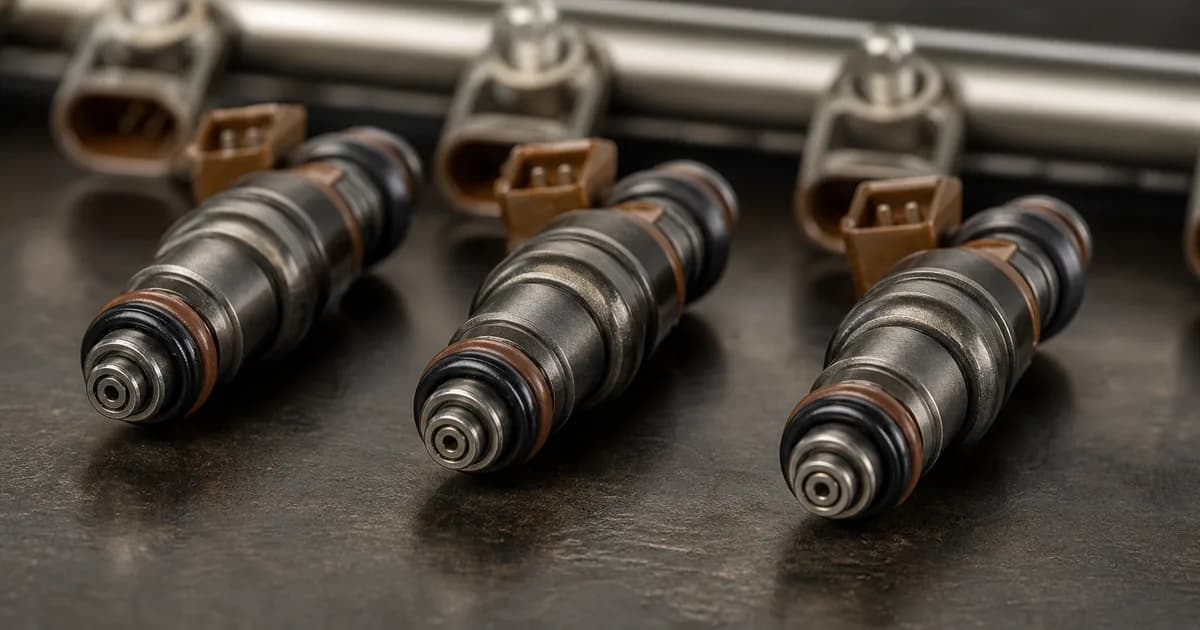
Fuel injectors are among the most demanding sealing environments in automotive engineering. Operating at fuel pressures of 30–200 bar and under-hood temperatures to +150°C, the O-rings in a fuel injector must resist ethanol-blended gasoline, biodiesel, aromatics, and aggressive fuel additives while maintaining leak-free performance for the life of the vehicle. A leaking injector seal causes hard starting, rough idle, fuel odor, increased emissions, and in extreme cases, engine fire risk. **Where O-Rings Seal in Fuel Injectors** **Upper injector seal (injector to fuel rail).** The top of the fuel injector seals against the fuel rail with an O-ring compressed between the injector body and the rail bore. This seal sees continuous fuel pressure (30–200 bar depending on system type) and must survive the highest temperatures in the fuel path because it sits closest to the cylinder head. When the upper seal leaks, fuel weeps into the injector well, creating a fire hazard and causing rough idle from uneven fuel delivery. **Lower injector seal (injector to intake manifold).** The lower seal isolates the fuel system from the intake manifold or cylinder head. This seal must resist both fuel exposure on one side and intake vacuum on the other. A failed lower seal allows unmetered air to enter the intake, leaning out the air-fuel ratio and causing misfires. **Fuel rail crossover fittings.** Many multi-point injection systems use O-ring-sealed fittings between fuel rail sections. These static seals must survive pressure spikes from fuel pump operation and thermal cycling from engine heat soak to cold start. **Modern Fuel Challenges** E10 (10% ethanol) and E85 (85% ethanol) gasoline blends attack standard NBR through ethanol permeation and oxidative degradation. Biodiesel (B20–B100) contains fatty acid methyl esters that hydrolyze standard NBR. Direct injection systems operate at 150–200 bar, creating extrusion forces that 70 Shore A NBR cannot survive without backup rings. Turbocharged engines create under-hood temperatures above +130°C, exceeding NBR's continuous limit. For modern fuel systems, [FKM 75–90 Shore A](/products/fkm/) is the premium standard — it resists all fuel types to +200°C and survives direct-injection pressures. [HNBR 70–80 Shore A](/products/hnbr/) is the cost-effective choice for port-injection systems running on E10 or biodiesel blends, offering fuel resistance to +150°C at roughly half the cost of FKM. **Common sizes:** Fuel injector O-rings are typically metric sizes in the 6–14 mm ID range with 1.5–2.5 mm cross-sections. Domestic vehicles commonly use 7.5×1.5 mm, 9×1.5 mm, and 11×2 mm. European vehicles frequently use 9.5×1.5 mm and 12×2 mm. Asian vehicles range from 6×1.5 mm to 10×1.5 mm. Because injector O-rings are under high pressure, dimensional precision is critical — a 0.1 mm undersized O-ring will leak; a 0.1 mm oversized O-ring will be pinched and cut during installation.
Application Requirements
Recommended Materials
FKM 75–90 Shore A
Direct injection (GDI/DSI), high-performance engines, turbocharged applications, and any fuel system operating above +120°C. Universal fuel resistance including E85 and biodiesel.
Temp: -20°C to +200°C
Premium standard for modern fuel systems. 90 Shore A for direct-injection pressures above 150 bar without backup rings. GFLT grade for cold-climate flexibility to -40°C.
HNBR 70–80 Shore A
Port fuel injection (PFI), E10 gasoline, biodiesel blends (B20–B50), and standard passenger vehicles. Cost-effective FKM alternative.
Temp: -40°C to +150°C
Saturated backbone resists ethanol and biofuels better than standard NBR. 80 Shore A recommended for high-pressure PFI systems. Not suitable for continuous +150°C or E85.
NBR 70 Shore A
Legacy vehicles running pure gasoline (non-ethanol) only. Standard for pre-2005 vehicles without ethanol blends.
Temp: -40°C to +120°C
NOT recommended for E10, E85, biodiesel, or direct injection. NBR hardens and shrinks in ethanol-blended fuels within months. Only specify for confirmed pure-gasoline applications.
Design Tips
- 1.Always replace fuel injector O-rings during injector service — fuel exposure causes compression set and hardening. Reused O-rings are the leading cause of post-service fuel leaks.
- 2.Lubricate new O-rings with clean engine oil or fuel-compatible silicone grease before installation. Never use petroleum grease on HNBR or FKM.
- 3.Verify fuel type before selecting material — E10 requires HNBR minimum; E85 and biodiesel require FKM.
- 4.For direct injection systems above 150 bar, specify 90 Shore A FKM or add PTFE backup rings to 75 Shore A FKM.
- 5.Do not substitute standard NBR for HNBR or FKM in modern fuel systems — ethanol and biofuel content will destroy NBR within 6–12 months.
- 6.Inspect injector wells for corrosion before installing new seals — rough surfaces damage O-rings and cause leaks even with correct material.
- 7.Use injector-specific seal kits containing both upper and lower O-rings — upper and lower seals often have different sizes and materials.
- 8.Allow engine to cool before servicing fuel injectors — hot fuel rail components cause burns and damage new O-rings during installation.
Common Sizes
| Size | Typical Use |
|---|---|
| Metric 6×1.5 mm | Small Asian import injectors (Honda, Toyota, Mazda) |
| Metric 7.5×1.5 mm | Domestic V6 and V8 port injectors (GM, Ford, Chrysler) |
| Metric 9×1.5 mm | European and domestic standard injectors (Bosch, Denso, Delphi) |
| Metric 9.5×1.5 mm | European direct injectors (Bosch HDEV, Continental) |
| Metric 10×1.5 mm | Large Asian and domestic injectors |
| Metric 11×2 mm | Heavy-duty and diesel injectors |
| Metric 12×2 mm | Large European diesel injectors (Bosch CP4, Siemens) |
Frequently Asked Questions
What is the best O-ring material for fuel injectors?
FKM 75–90 Shore A is the premium standard for modern fuel injectors. It resists all fuel types including E10, E85, biodiesel, and synthetic fuels, and survives under-hood temperatures to +200°C. HNBR 70–80 Shore A is the cost-effective alternative for port-injection systems running E10 or biodiesel blends. NBR is NOT recommended for modern fuels — ethanol and biofuel content rapidly degrades NBR.
Can I use NBR O-rings in fuel injectors?
Only for legacy vehicles running pure gasoline (no ethanol). NBR hardens, shrinks, and cracks when exposed to E10, E85, or biodiesel. In modern fuel systems, NBR failure typically occurs within 6–12 months. For any vehicle manufactured after 2005 or running ethanol-blended fuel, specify HNBR minimum — or FKM for direct injection and high-performance engines.
What size O-ring fits a Bosch fuel injector?
Bosch injectors commonly use metric sizes: 9×1.5 mm for standard port injectors (EV1, EV6 connectors), 9.5×1.5 mm for direct injectors (HDEV5, HDEV6), and 12×2 mm for diesel common-rail injectors. Always measure the removed O-ring with digital calipers before ordering — Bosch injector families vary by application, and using the wrong size causes immediate leakage or seal damage during installation.
How often should fuel injector O-rings be replaced?
Replace fuel injector O-rings every time the injector is removed for service. Fuel exposure causes compression set and surface hardening that makes reused seals unreliable. As preventive maintenance, replace injector seals at 100,000 km (60,000 miles) for port-injection systems and 80,000 km (50,000 miles) for direct-injection systems. Turbocharged and high-performance engines may require more frequent replacement due to higher thermal stress.
What causes fuel injector O-rings to leak?
The most common causes are: (1) Material incompatibility — using NBR with ethanol or biodiesel; (2) Compression set — aged O-rings lose elastic recovery; (3) Physical damage — nicks or cuts from improper installation; (4) Corroded injector bores — rough surfaces damage the seal; (5) Wrong size — undersized O-rings leak; oversized O-rings get pinched; (6) Reuse — installing a seal that has already taken compression set.
Do you supply fuel injector O-ring kits?
Yes, we supply fuel injector seal kits containing upper and lower O-rings in FKM or HNBR for all common injector families: Bosch EV1/EV6/EV14, Denso, Delphi, Siemens, and Continental. Kits include the correct sizes and material grades for gasoline, diesel, E85, and biodiesel applications. Custom kits for specific engine platforms are available on request. MOQ from 1 piece.
Need fuel injector O-rings?
We supply FKM and HNBR fuel injector seals in standard and custom sizes for gasoline, diesel, E85 and biodiesel systems. Seal kits available. MOQ 1 piece.