
Chemical-Resistant O-Ring Selection Guide
Acid, solvent and caustic-resistant seals. Compare FKM, FFKM, PTFE, EPDM and AFLAS for your chemical environment.
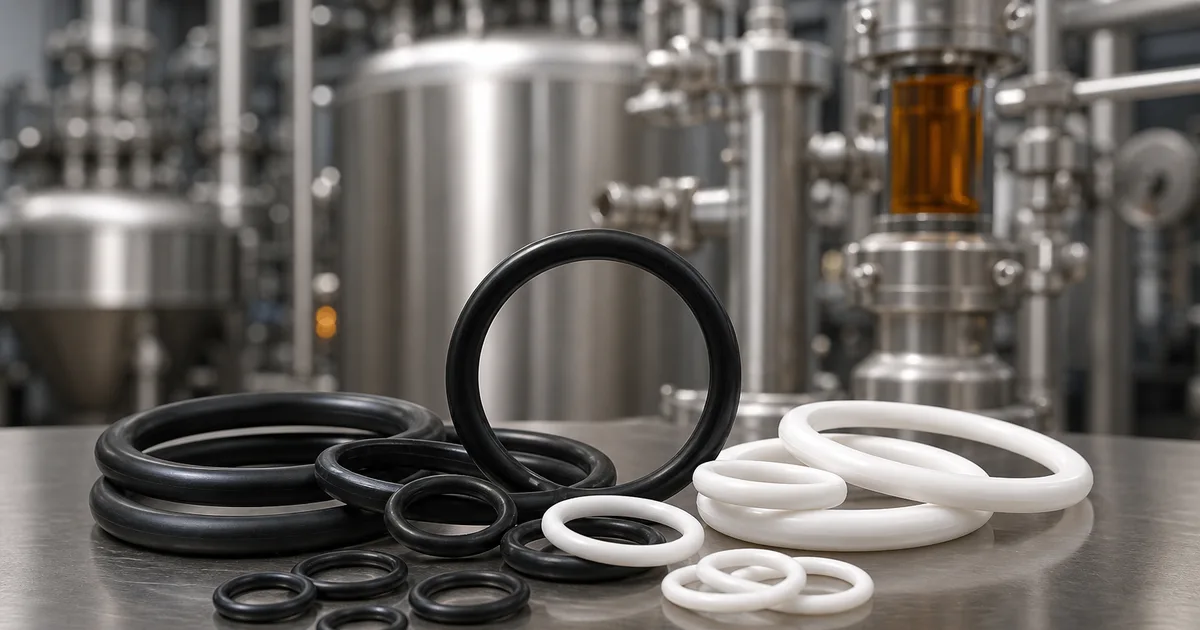
Chemical compatibility is the single most important factor in O-ring material selection after temperature. An O-ring exposed to an incompatible chemical swells, cracks, or dissolves — sometimes within minutes. This guide matches common chemical classes to the correct O-ring material, with a compatibility summary table and links to detailed material pages. For a searchable chemical compatibility database covering 50+ fluids, use our [Chemical Compatibility Tool](/tools/chemical-compatibility/). **Chemical-resistant O-ring materials by environment:** | Chemical Class | Examples | Best Materials | Avoid | |---|---|---|---| | Strong acids (conc.) | H₂SO₄, HCl, HNO₃, HF | [PTFE](/products/ptfe/), [FFKM](/products/ffkm/), [FKM](/products/fkm/) | NBR, EPDM, VMQ | | Strong bases (caustic) | NaOH, KOH, ammonia | [AFLAS](/products/aflas/), [EPDM](/products/epdm/), [PTFE](/products/ptfe/) | FKM, NBR | | Ketones | Acetone, MEK | [FFKM](/products/ffkm/), [PTFE](/products/ptfe/) | FKM, NBR | | Esters | Ethyl acetate, POE oil | [FFKM](/products/ffkm/), [PTFE](/products/ptfe/) | NBR (severe swell) | | Aromatic solvents | Toluene, xylene | [FKM](/products/fkm/), [FFKM](/products/ffkm/), [PTFE](/products/ptfe/) | NBR, EPDM | | Chlorinated solvents | TCE, methylene chloride | [FKM](/products/fkm/), [FFKM](/products/ffkm/), [PTFE](/products/ptfe/) | NBR, EPDM | | Amines | MEA, DEA, hydrazine | [FFKM](/products/ffkm/), [AFLAS](/products/aflas/), [PTFE](/products/ptfe/) | FKM (attacks) | | Oxidizers | H₂O₂, ozone, ClO₂ | [FKM](/products/fkm/), [PTFE](/products/ptfe/), [FFKM](/products/ffkm/) | NBR, CR | | Alcohols | Methanol, ethanol, IPA | [EPDM](/products/epdm/), [VMQ](/products/vmq/), [FKM](/products/fkm/) | Most are acceptable | **Material deep dives for chemical resistance:** **[PTFE](/products/ptfe/)** is the chemical resistance benchmark. It resists virtually all industrial chemicals including concentrated sulfuric acid, hydrofluoric acid, strong alkalis, ketones, esters, and oxidizing agents. PTFE is not an elastomer — it is a rigid fluoropolymer with no elastic recovery — so it is limited to static sealing applications. For dynamic chemical sealing, use spring-energized PTFE seals. **[FFKM](/products/ffkm/)** is the only elastomer that combines elastic recovery with near-universal chemical resistance. It handles ketones, esters, and concentrated amines that destroy FKM. Temperature range to +325°C. Cost is 50–100× NBR, but for critical chemical reactors and semiconductor equipment, the cost of failure exceeds the material premium. **[FKM](/products/fkm/)** handles most acids, fuels, aromatic hydrocarbons, and chlorinated solvents to +200°C. It is the workhorse of chemical-resistant sealing — cost-effective for the majority of aggressive environments. Limitations: ketones, strong bases, amines, and steam cause dehydrofluorination and cracking. **[AFLAS](/products/aflas/)** is the base-resistant specialist. It outperforms FKM in caustic soda, steam, and amine environments while maintaining +230°C capability. Incompatible with aromatic hydrocarbons and ketones. The correct choice for alkaline chemical processing and geothermal steam. **[EPDM](/products/epdm/)** handles dilute acids, alkalis, polar solvents, and steam to +150°C. It is not suitable for concentrated acids or hydrocarbon solvents. The economical choice for water treatment, steam, and mild chemical environments. For definitive compatibility verification, submit your specific chemical formulation for ASTM D471 immersion testing at operating temperature.
Application Requirements
Recommended Materials
PTFE 55–65 Shore D
Universal chemical resistance for static seals in the most aggressive acids, solvents, and oxidizers. FDA and USP Class VI compliant.
Temp: -200°C to +260°C
Not an elastomer — no elastic recovery. Static service only. Use spring-energized PTFE for dynamic chemical sealing.
FFKM 75 Shore A
Ultra-aggressive chemicals including ketones, esters, and concentrated amines where elastic recovery is required. Semiconductor and chemical reactor seals.
Temp: -15°C to +325°C
Only elastomer for ketones and amines. 50–100× NBR cost. Justified for critical applications where downtime costs exceed material costs.
FKM 75 Shore A
General chemical resistance for acids, fuels, aromatics, and chlorinated solvents. The cost-effective standard for most aggressive environments.
Temp: -20°C to +200°C
Do not use with ketones, strong bases, amines, or steam. GFLT grade available for low-temperature flexibility to -40°C.
AFLAS 80 Shore A
Caustic environments, steam, and amines where FKM fails. Oil & gas sour gas and geothermal applications.
Temp: -5°C to +230°C
Not compatible with aromatic hydrocarbons or ketones. The base-resistant alternative to FKM.
EPDM 70 Shore A
Dilute acids, alkalis, polar solvents, and steam to +150°C. Economical for water treatment and mild chemical service.
Temp: -50°C to +150°C
Not suitable for concentrated acids or hydrocarbon solvents. Use FKM or PTFE for aggressive chemicals.
Design Tips
- 1.Never guess chemical compatibility. Use our Chemical Compatibility Tool or request ASTM D471 test data for your specific fluid at operating temperature.
- 2.For mixed chemical streams, test the exact mixture — compatibility with individual components does not guarantee compatibility with the blend.
- 3.Temperature accelerates chemical attack. A material that survives 70h at 23°C may fail in 24h at 100°C. Always test at maximum operating temperature.
- 4.For concentrated acids above 90%, specify virgin PTFE or FFKM — filled PTFE and lower-grade elastomers may show unexpected attack.
- 5.In chemical reactors with thermal cycling, FFKM outperforms FKM due to superior compression set resistance at temperature.
- 6.For static chemical flange seals, encapsulated O-rings (FEP shell + elastomer core) provide PTFE-level resistance with elastomer seating force.
- 7.Always replace O-rings after any chemical exposure incident — residual chemicals may continue to degrade the polymer even after the bulk fluid is removed.
- 8.For FDA-compliant chemical seals, verify that the specific compound grade (not just the material family) carries the required FDA or USP certification.
Common Sizes
| Size | Typical Use |
|---|---|
| AS568-006 to -050 | Small instrument and valve seals in chemical processing |
| AS568-110 to -160 | Medium process line and pump seals |
| AS568-210 to -260 | Large vessel and reactor flange seals |
| ISO 3601 metric sizes | European chemical equipment and DIN-standard flanges |
Frequently Asked Questions
What is the most chemical-resistant O-ring material?
PTFE (Teflon) is the most chemically resistant sealing material — it resists virtually all industrial chemicals except molten alkali metals and elemental fluorine at high temperature. However, PTFE is not an elastomer and has no elastic recovery. For applications requiring both chemical resistance and elasticity, FFKM (perfluoroelastomer) is the only option — it handles ketones, esters, and amines that destroy FKM.
Can I use FKM O-rings with acetone or MEK?
No. Ketones including acetone, MEK, and cyclohexanone cause rapid dehydrofluorination of FKM, leading to surface cracking, hardening, and seal failure within hours to days. For ketone service, specify FFKM or PTFE. This is one of the most common and expensive chemical compatibility mistakes in seal design.
What O-ring material is best for sulfuric acid?
For concentrated sulfuric acid (above 50%), PTFE is the safest choice at all temperatures. FKM handles concentrated sulfuric acid to +100°C reliably. FFKM is required for hot concentrated acid above +100°C or when the acid contains oxidizing contaminants. EPDM is suitable only for dilute sulfuric acid (<20%) at ambient temperature.
Are there FDA-compliant chemically resistant O-rings?
Yes. Virgin PTFE is FDA 21 CFR §177.1550 compliant and handles virtually all chemicals. FEP encapsulated O-rings with FDA-compliant VMQ or FKM cores are FDA compliant for food and pharmaceutical chemical processing. FFKM is available in ultra-high-purity semiconductor and pharmaceutical grades with full extractables documentation. Always verify the specific compound grade carries the required certification — not all formulations within a material family are FDA approved.
Need chemical-resistant O-rings?
We supply FKM, FFKM, PTFE, AFLAS and EPDM O-rings for acid, solvent and caustic environments. ASTM D471 test data available. Custom sizes from MOQ 1 piece.