
Automotive O-Rings
Engine, fuel, oil, cooling, transmission and brake system seals. NBR, HNBR and FKM by automotive application.
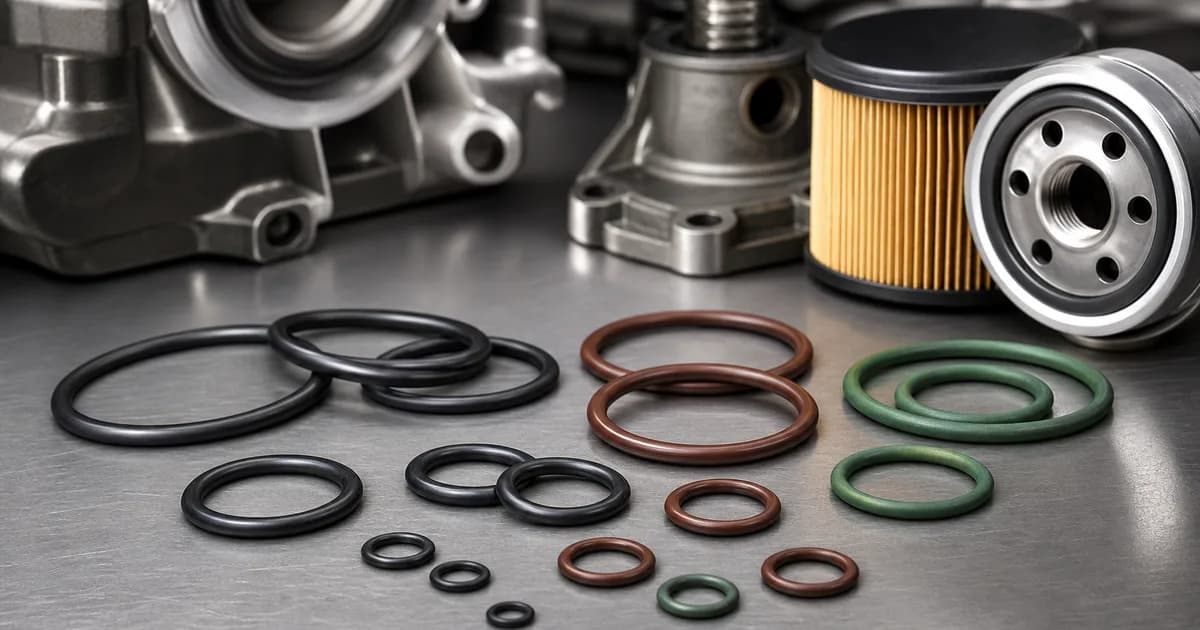
Automotive vehicles contain hundreds of O-rings across every fluid system. From the engine oil filter to the power steering pump, fuel injectors, transmission cooler, and brake master cylinder, each seal must survive specific fluids, temperatures, and pressures. Using the wrong material in an automotive system causes fluid leaks, component damage, and in safety-critical systems like brakes, potential accident risk. This guide organizes automotive O-ring applications by system, identifies the correct material for each, and provides common sizes and replacement guidance. **Engine Oil System** **Oil filter gasket / O-ring.** Spin-on and cartridge oil filters use a large-diameter O-ring or gasket to seal against the engine block. This seal must resist hot engine oil (+100°C to +150°C continuous) and survive thousands of thermal cycles. [NBR 70 Shore A](/products/nbr/) is standard for conventional oil filters. [HNBR 80 Shore A](/products/hnbr/) is required for high-performance and synthetic oil applications above +130°C. **Oil cooler lines and fittings.** Oil cooler hoses and adapter fittings use O-rings that must resist hot oil and vibration. [FKM 75 Shore A](/products/fkm/) is specified for many OEM oil cooler connections due to its superior heat resistance. **Oil pan drain plug.** The drain plug uses a crush washer or O-ring to seal against the pan. [NBR](/products/nbr/) or [HNBR](/products/hnbr/) are standard, with copper or aluminum crush washers also common. **Valve cover and timing cover.** Valve cover gaskets are typically molded rubber gaskets, but some designs use O-ring seals around the spark plug tubes or timing chain tensioner ports. [FKM](/products/fkm/) is specified for turbocharged engines where under-hood temperatures exceed +150°C. **Cooling System** **Radiator hoses and coolant fittings.** Radiator and heater hose connections use O-rings in quick-connect fittings and adapter unions. These seals must resist glycol-based coolant (ethylene or propylene glycol), water pump pulsation, and temperatures from -40°C to +120°C. [EPDM 70 Shore A](/products/epdm/) is the standard — it handles glycol and hot water while NBR fails in glycol within months. **Thermostat housing.** The thermostat housing gasket is often an O-ring design, sealing the thermostat body to the engine block or intake manifold. [EPDM](/products/epdm/) handles the coolant and thermal cycling. **Water pump.** Water pumps use O-rings or gaskets at the pump-to-block interface. [EPDM](/products/epdm/) is standard for the coolant contact. **Fuel System** **Fuel injectors.** The most critical fuel system seals. Upper and lower injector O-rings must resist fuel pressure (30–200 bar), fuel type (gasoline, E10/E85, diesel, biodiesel), and under-hood heat. [FKM 75–90 Shore A](/products/fkm/) is standard for direct injection. [HNBR 70–80 Shore A](/products/hnbr/) is used for port injection with E10. See our dedicated [fuel injector O-ring guide](/applications/fuel-injector/) for details. **Fuel rail and lines.** Fuel rail crossover fittings and fuel line quick-connects use O-rings in FKM or HNBR. **Fuel cap seal.** The fuel filler cap uses an O-ring to seal against fuel vapor escape. [FKM](/products/fkm/) or [HNBR](/products/hnbr/) resists fuel vapors and UV. **Power Steering** **Power steering pump and rack.** Power steering systems use O-rings in the pump, rack, and hose connections. These seals must resist automatic transmission fluid (ATF) or dedicated power steering fluid, and survive pressures of 50–80 bar. [HNBR 80 Shore A](/products/hnbr/) is increasingly specified for modern systems. [NBR 90 Shore A](/products/nbr/) is standard for older systems. **Transmission** **Transmission cooler lines.** Automatic transmission cooler lines use O-rings at the radiator and transmission connections. These seals must resist ATF and temperatures to +150°C. [FKM](/products/fkm/) or [HNBR](/products/hnbr/) are specified for modern transmissions. **Brakes** **Master cylinder and wheel cylinders.** Brake system seals use O-rings or cups in the master cylinder, wheel cylinders, and calipers. These must resist glycol-based brake fluid (DOT 3/4/5.1) and remain flexible across temperature extremes. EPDM or [Butyl](/products/butyl/) are the correct materials — NBR and PU are attacked by glycol brake fluid. **Exhaust** **EGR valve and exhaust sensors.** EGR valves and oxygen sensor bungs use high-temperature seals. [FKM](/products/fkm/) handles EGR temperatures to +200°C. [FFKM](/products/ffkm/) or graphite seals are required for extreme exhaust temperatures above +250°C.
Application Requirements
Recommended Materials
NBR 70–90 Shore A
Engine oil systems (filters, drain plugs), older power steering, non-ethanol fuel systems. The default for general automotive seals below +120°C.
Temp: -40°C to +120°C
Standard for most legacy automotive applications. Use 90 Shore A for high-pressure power steering. NOT for coolant, brake fluid, or ethanol blends.
HNBR 70–80 Shore A
Modern fuel systems (E10, biodiesel), high-temp oil systems, power steering, and transmission seals. Superior to NBR for biofuels and heat.
Temp: -40°C to +150°C
The cost-effective upgrade from NBR for modern vehicles. Saturated backbone resists ethanol, biofuels, and ozone. Specify for any vehicle running E10 or newer.
FKM 75–90 Shore A
Direct fuel injection, turbocharged engines, high-temp oil coolers, EGR valves, and any application above +150°C.
Temp: -20°C to +200°C
Premium automotive standard. 90 Shore A for direct injection pressures. GFLT grade for cold-climate flexibility to -40°C. NOT for coolant or brake fluid.
EPDM 70 Shore A
Cooling system seals — radiator hoses, thermostat housings, water pumps, and heater cores. The only correct material for glycol coolant.
Temp: -50°C to +150°C
Standard for all coolant system seals. Resists glycol, hot water, and thermal cycling. Never use NBR in coolant — severe swell and failure within weeks.
Butyl (IIR) 70 Shore A
Brake system master cylinder and wheel cylinder seals. Superior resistance to glycol brake fluid.
Temp: -40°C to +120°C
Resists DOT 3/4/5.1 brake fluid with minimal swell. NOT for oil or fuel contact. EPDM is an acceptable alternative for brake fluid.
Design Tips
- 1.Never use NBR in cooling systems — glycol coolant attacks NBR, causing 50–100% volume swell and seal failure within weeks. Use EPDM for all coolant seals.
- 2.Never use NBR with ethanol-blended fuel (E10+) or biodiesel — specify HNBR minimum, or FKM for direct injection.
- 3.Replace all O-rings when servicing fuel injectors, brake calipers, or power steering racks — fuel and brake fluid harden seals, and reuse causes leaks.
- 4.For turbocharged engines, specify FKM for all seals near the turbo or exhaust manifold — sustained temperatures exceed NBR and HNBR limits.
- 5.Use only brake-fluid-compatible lubricant (silicone grease) on brake system O-rings — petroleum grease contaminates brake fluid and attacks EPDM.
- 6.Inspect transmission cooler line O-rings during every fluid change — ATF heat causes compression set, and a leaking cooler line destroys the transmission.
- 7.For classic cars running pure gasoline, NBR is acceptable for fuel and oil seals — but upgrade to HNBR for any vehicle converted to E10.
- 8.Keep a vehicle-specific O-ring kit for common repairs — most automotive leaks can be fixed with 5–10 standard sizes in the correct materials.
Common Sizes
| Size | Typical Use |
|---|---|
| Metric 6×1.5 mm | Fuel injector lower seals, small sensor ports |
| Metric 7.5×1.5 mm | Fuel injector upper seals (domestic V6/V8) |
| Metric 9×1.5 mm | Standard fuel injector seals (Bosch, Denso) |
| Metric 10×2 mm | Oil filter adapter seals, coolant sensor seals |
| Metric 14×2.5 mm | Oil filter spin-on gasket, power steering line seals |
| Metric 16×2.5 mm | Transmission cooler line seals, large coolant fittings |
| Metric 19×2.5 mm | Brake master cylinder seals, large oil cooler fittings |
Frequently Asked Questions
What O-ring material is best for automotive applications?
There is no single best material — it depends on the system: NBR for oil and pure gasoline below +120°C; HNBR for modern fuels (E10, biodiesel) and temperatures to +150°C; FKM for direct injection, turbocharged engines, and temperatures above +150°C; EPDM for coolant and hot water; Butyl or EPDM for brake fluid. Using the wrong material causes leaks and component damage. Match the material to the fluid and temperature.
Can I use NBR O-rings for coolant?
No. NBR swells 50–100% in glycol coolant and fails within weeks. EPDM is the correct material for all cooling system seals — radiator hoses, thermostat housings, water pumps, and heater cores. EPDM resists glycol, hot water, and thermal cycling. Using NBR in a coolant system is one of the most common and costly mistakes in automotive repair.
What size O-ring fits an oil filter?
Spin-on oil filters typically use a large-diameter O-ring (14×2.5 mm to 22×3 mm) as the base gasket. The exact size varies by filter model — common sizes: 14×2.5 mm (small filters), 16×2.5 mm (standard), 19×2.5 mm (large), and 22×3 mm (heavy-duty). Cartridge-style filters use smaller O-rings (10×2 mm to 14×2.5 mm) at the filter cap. Always use the O-ring supplied with the new filter or measure the removed seal.
Why do power steering seals leak?
Power steering leaks are typically caused by: (1) aged O-rings that have taken compression set; (2) high pressure (50–80 bar) exceeding the material capability; (3) wrong material — NBR 70A may extrude at high pressure; (4) contaminated fluid — dirt and metal particles score the seal surface. Fix: replace all O-rings in the leaking component, flush the system with clean fluid, and verify the correct material (HNBR 80A or FKM 75A for modern systems).
Can I use the same O-ring for fuel and coolant?
No. Fuel-resistant materials (NBR, HNBR, FKM) are attacked by glycol coolant. Coolant-resistant materials (EPDM) are attacked by fuel and oil. A fuel-system O-ring used in coolant will swell and fail; a coolant O-ring used in fuel will degrade. Always use the material specified for the fluid. Cross-contamination of materials between systems is a common cause of repeat leaks.
Do you supply automotive O-ring kits?
Yes, we supply automotive O-ring kits organized by system: engine oil (NBR/HNBR), fuel injection (FKM/HNBR), cooling (EPDM), power steering (HNBR/FKM), transmission (FKM/HNBR), and brakes (EPDM/Butyl). Kits include the most common metric and AS568 sizes for domestic, European, and Asian vehicles. Custom kits for specific makes and models are available on request. MOQ from 1 kit.
Need automotive O-rings?
We supply NBR, HNBR, FKM, EPDM and Butyl O-rings for engine, fuel, cooling, transmission and brake systems. Vehicle-specific kits available. MOQ 1 piece.