
Automotive Air Conditioning O-Rings & Kits
HNBR and FKM O-rings for R134a and R1234yf AC systems. Compatible with PAG and POE oils, common sizes, replacement procedures and bulk kits for auto repair shops.
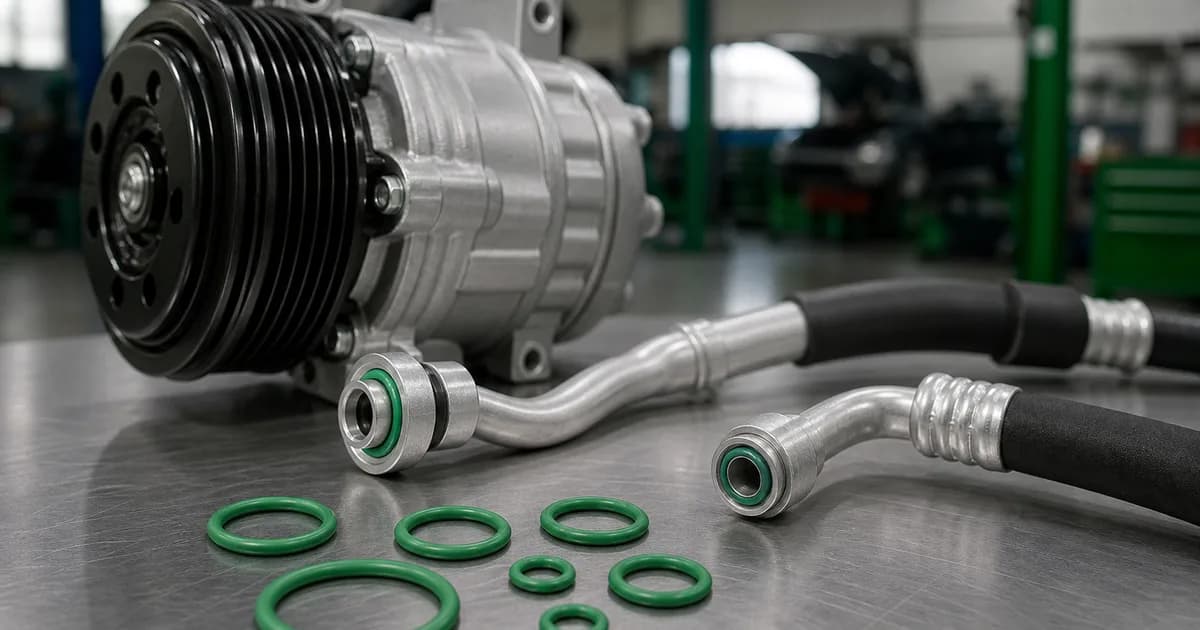
Automotive air conditioning systems are unforgiving environments for seals. Refrigerant gas under pressure, synthetic lubricants, extreme under-hood temperatures, and zero-tolerance for leakage make O-ring selection critical. A leaking AC system loses refrigerant, degrades cooling performance, damages the compressor from oil starvation, and releases fluorinated greenhouse gases to the atmosphere. This guide covers every sealing point in an automotive AC system, the materials that survive modern refrigerants, the common sizes found across vehicle platforms, and step-by-step replacement procedures for technicians and DIYers. **Where O-Rings Are Used in Automotive AC Systems** Automotive AC systems use O-rings at every joint where rigid metal lines connect to flexible hoses, compressors, condensers, evaporators, and expansion devices: **Compressor ports.** The compressor is the heart of the system, and its suction and discharge ports use O-ring face seals where the refrigerant lines attach. These seals see the highest pressures (up to 35 bar on the discharge side) and the widest temperature swings-from cold suction gas to hot compressed gas. Compressor port O-rings must also survive vibration from the engine and the compressor itself. **Refrigerant line joints.** Metal refrigerant lines are joined with flare fittings sealed by O-rings. These joints exist throughout the system: between the compressor and condenser, the condenser and receiver-drier (or accumulator), and the evaporator and expansion valve (or orifice tube). Each joint must maintain seal integrity through thousands of thermal cycles and vibration events. **Expansion valve and orifice tube connections.** The expansion valve meters refrigerant into the evaporator and uses O-rings on its inlet and outlet fittings. These seals experience rapid temperature drops as liquid refrigerant flashes to gas, creating thermal shock that can crack incompatible materials. **Service ports (Schrader and quick-connect).** AC service ports use small O-rings on the valve cores and port caps. These seals are often overlooked but are common leak points, especially when caps are lost or cross-threaded. **Condenser and evaporator fittings.** The condenser and evaporator have inlet and outlet fittings sealed by O-rings. Evaporator seals are particularly challenging because they operate in a cold, moist environment where condensation can accelerate corrosion of the mating surfaces. **Refrigerant-Compatible Materials: HNBR, FKM and NBR** The refrigerant type determines the required O-ring material: **HNBR 70 Shore A.** Hydrogenated nitrile is the modern standard for R134a and R1234yf automotive AC systems. HNBR's saturated polymer backbone provides excellent resistance to refrigerants, PAG oil, POE oil, and the elevated temperatures found under the hood. It also resists ozone and weathering better than standard NBR. [HNBR](/products/hnbr/) has become the OEM-specified material for virtually all new vehicle AC systems since the mid-1990s and is mandatory for R1234yf due to that refrigerant's higher chemical reactivity. **FKM 75 Shore A.** Fluoroelastomer is specified for high-temperature under-hood applications where continuous exposure to +150 degrees C or higher is expected. [FKM](/products/fkm/) offers the best chemical resistance of any elastomer and is fully compatible with R134a, R1234yf, PAG oil, and POE oil. It is commonly used in luxury and performance vehicles where under-hood temperatures are extreme. FKM is also the correct material for older systems originally charged with R12 (CFC-12), as it resists the mineral oil lubricants used with that refrigerant. **NBR 70 Shore A.** Standard nitrile is compatible with older R12 systems using mineral oil but is not recommended for R134a or R1234yf. NBR suffers from excessive swelling in PAG oil and has poor resistance to the higher operating temperatures of modern AC systems. If you are servicing an older R12 system, NBR may be acceptable, but upgrading to HNBR or FKM provides better longevity. Never use NBR in a modern R134a or R1234yf system. **Compatibility summary:** R134a + PAG/POE oil -> HNBR (standard) or FKM (high temp). R1234yf + PAG oil -> HNBR (mandatory) or FKM (high temp). R12 + mineral oil -> FKM (best) or NBR (acceptable for old systems only). **Common Sizes and Kits** Automotive AC systems use a relatively small set of standard AS568 sizes across most vehicle platforms: | Application | Typical AS568 Sizes | Cross-Section | |---|---|---| | Small line fittings | -006, -007, -008, -009, -010 | 1.78 mm | | Compressor ports | -011, -012, -013, -014, -015, -016 | 1.78 mm | | Large hose fittings | -110, -111, -112, -113, -114, -115, -116 | 2.62 mm | | Service port caps | -009, -010, -011 | 1.78 mm | A typical [AC O-ring kit](/products/kits/) contains 100-200 pieces in 10-15 sizes, organized by size in a compartment box. Professional shops use master kits containing HNBR and FKM seals in all common sizes, plus color-coded sizes for quick identification. Bulk quantities are available for high-volume shops. When ordering individual seals, always specify the material (HNBR for R134a/R1234yf, FKM for high-temp or R12). Using the wrong material will cause swelling, hardening, or leakage within weeks. We supply AC O-rings with material color coding: green for HNBR, brown for FKM, and black for NBR, so technicians can verify material at a glance. **Replacement Procedure for Technicians** Follow this procedure to replace AC O-rings correctly and prevent comebacks: **Step 1: Recover refrigerant.** Never vent refrigerant to the atmosphere. Use a certified recovery machine to extract all refrigerant from the system. R134a and R1234yf are regulated substances; venting is illegal in most jurisdictions and environmentally harmful. **Step 2: Disconnect the fitting.** Use the correct line wrenches (flare nut wrenches) to avoid rounding the fitting hex. Support the component (compressor, condenser, etc.) so the fitting is not loaded during disassembly. **Step 3: Remove the old O-ring.** Use a plastic pick to lift the old seal from its groove. Do not use a metal screwdriver-scratching the groove creates a permanent leak path. Inspect the old O-ring for swelling, hardening, cracking, or compression set. These symptoms indicate material incompatibility or thermal degradation. **Step 4: Clean the sealing surfaces.** Use lint-free wipes and isopropyl alcohol to clean the groove and the mating flare surface. Remove all traces of old refrigerant oil, debris, and corrosion. Inspect the flare surface for scratches, pitting, or deformation. A damaged flare will leak regardless of the O-ring quality. **Step 5: Lubricate the new O-ring.** Apply clean PAG oil (for R134a/R1234yf) or POE oil to the new seal. The lubricant helps the O-ring seat properly and prevents damage during assembly. Do not use mineral oil on HNBR in an R134a system-mineral oil is incompatible with PAG and can cause system damage. **Step 6: Install the O-ring.** Roll the O-ring into the groove without stretching it more than necessary. Ensure it sits evenly in the groove with no twists. The O-ring should protrude slightly above the groove face to make proper contact with the flare. **Step 7: Reassemble and torque.** Reconnect the fitting and tighten to the manufacturer's torque specification. Overtightening crushes the O-ring; undertightening allows leakage. Typical torque for M8-M12 flare fittings is 15-30 N-m; consult the vehicle service manual. **Step 8: Evacuate and recharge.** Pull a vacuum on the system for at least 30 minutes (longer for humid conditions) to remove air and moisture. Recharge with the correct refrigerant quantity and oil type. Leak-test with an electronic leak detector or UV dye. **Key Safety Note:** Always replace every O-ring on a disconnected fitting. Never reuse an O-ring, even if it looks fine. The compression set from the first installation means the seal will not recover to its original shape, and leakage is guaranteed. **R1234yf Considerations** R1234yf is the new global standard refrigerant replacing R134a due to its lower global warming potential (GWP). However, R1234yf is mildly flammable (A2L classification) and more chemically reactive than R134a. This has implications for seal selection: **HNBR is mandatory.** OEMs specify HNBR for all R1234yf seals due to its superior chemical stability with the new refrigerant. NBR is not acceptable. **Use R1234yf-certified oils.** PAG oils for R1234yf have a different viscosity and additive package than R134a PAG oils. Do not mix oils. **Service equipment compatibility.** R1234yf requires dedicated recovery, recycling, and charging equipment. Do not use R134a equipment for R1234yf. **Leak detection.** R1234yf leak detectors are calibrated differently from R134a detectors. Ensure your equipment is certified for the refrigerant you are servicing.
Application Requirements
Recommended Materials
HNBR 70 Shore A
Modern automotive AC systems using R134a or R1234yf refrigerant with PAG/POE lubricants. The OEM standard for virtually all vehicles manufactured since the mid-1990s.
Temp: -40 degrees C to +150 degrees C
Mandatory for R1234yf systems due to superior chemical stability with the more reactive refrigerant. Good ozone and weathering resistance. Color-coded green for easy identification.
FKM 75 Shore A
High-temperature under-hood applications, luxury and performance vehicles, and older R12 systems using mineral oil lubricant.
Temp: -20 degrees C to +200 degrees C
Best chemical resistance of any AC seal material. Ideal for extreme under-hood temperatures or when maximum service life is required. Higher cost than HNBR but longer lasting in severe conditions. Color-coded brown.
NBR 70 Shore A
Older R12 automotive AC systems only. Not recommended for R134a or R1234yf systems.
Temp: -40 degrees C to +120 degrees C
Swells excessively in PAG oil and degrades at modern AC operating temperatures. Use only for classic vehicles still running R12 with mineral oil. Color-coded black.
Design Tips
- 1.Replace every O-ring whenever an AC fitting is disconnected. Never reuse O-rings-compression set guarantees leakage.
- 2.Always lubricate new O-rings with clean PAG or POE oil before installation. Dry installation causes nicks and improper seating.
- 3.Use flare nut wrenches, not open-end wrenches, to prevent rounding fitting hexes and creating leak paths.
- 4.Clean sealing surfaces with isopropyl alcohol and lint-free wipes. Even a grain of sand will create a leak under AC pressure.
- 5.Torque fittings to the vehicle manufacturer's specification. Overtightening crushes the seal; undertightening leaves gaps.
- 6.Pull a deep vacuum (below 500 microns) for at least 30 minutes before recharging. Moisture is the enemy of AC systems.
- 7.Store AC O-ring kits in sealed containers. Ozone and UV light degrade elastomers even before installation.
- 8.Color-code your inventory: green for HNBR, brown for FKM, black for NBR. This prevents material mix-ups during busy service.
Common Sizes
| Size | Typical Use |
|---|---|
| AS568-006 to -010 | Small refrigerant line fittings, service port caps, and orifice tube connections |
| AS568-011 to -016 | Compressor suction and discharge ports, expansion valve fittings |
| AS568-110 to -116 | Large-diameter hose fittings, condenser and evaporator connections |
Frequently Asked Questions
What is the best O-ring material for automotive AC systems?
HNBR 70 Shore A is the best choice for modern R134a and R1234yf systems. It offers excellent compatibility with synthetic refrigerants and PAG/POE oils, plus superior resistance to under-hood temperatures and ozone. FKM 75 Shore A is an upgrade for extreme temperatures and is mandatory for R12 systems with mineral oil. NBR is only acceptable for old R12 systems and should never be used with R134a or R1234yf due to excessive swelling in PAG oil and poor heat resistance.
Can I use a universal AC O-ring kit on any vehicle?
A quality universal AC O-ring kit contains the most common sizes (AS568-006 to -116) in HNBR and covers the majority of passenger vehicles from the mid-1990s onward. However, some vehicles use proprietary sizes or non-standard metric O-rings that may not be in a universal kit. European and Asian vehicles sometimes use DIN-standard sizes rather than AS568. For professional shops, we recommend a master kit containing universal sizes plus a supplemental kit for specific makes. Always verify the size before installation-an oversized O-ring will extrude and leak; an undersized one will not seal.
Why does my AC system keep leaking after replacing the O-rings?
The most common causes are: reusing old O-rings (compression set prevents resealing); wrong material (NBR in an R134a system will swell and leak within weeks); damaged flare surface (scratches or deformation on the metal fitting create leak paths that no O-ring can seal); insufficient lubrication (dry O-rings nick during assembly and leak); incorrect torque (overtightening crushes the seal, undertightening leaves gaps); and contamination (dirt or moisture on the sealing surface prevents contact). Also check that you replaced all O-rings on the fitting-many joints have two seals, one on each side of a union.
How do I know if my vehicle uses R134a or R1234yf?
Check the refrigerant label on the underside of the hood or near the service ports. R1234yf vehicles have a label stating R1234yf and often have unique service port fittings (SAE J2842) that are slightly different from R134a ports to prevent cross-contamination. R1234yf systems began appearing in 2013-2014 and became mandatory for new vehicles in the EU and US by 2017. If you are unsure, use an identifier tool on the refrigerant or consult the owner's manual. Never guess-the seal materials and service equipment are different.
Can I mix HNBR and FKM O-rings in the same AC system?
Yes, in most cases. HNBR and FKM are both fully compatible with R134a, R1234yf, PAG oil, and POE oil. Many OEMs use HNBR as the standard material but specify FKM for high-temperature locations like the compressor discharge port. In practice, a system with both materials will function correctly. The key is to avoid mixing NBR with HNBR/FKM-NBR is incompatible with modern refrigerants and oils and will degrade, potentially contaminating the system with rubber particles that clog the expansion valve. If retrofitting an old system, replace all seals with HNBR or FKM.
Do I need special tools to replace AC O-rings?
The essential tools are: a refrigerant recovery machine (legally required, do not vent); flare nut wrenches (prevent rounding fitting hexes); a plastic O-ring pick (prevents groove damage); lint-free wipes and isopropyl alcohol (for cleaning); a torque wrench (for correct fitting torque); and a vacuum pump with gauge (for proper evacuation). Optional but recommended: electronic leak detector or UV dye kit for verification; digital caliper for measuring O-ring size if the original is missing; and a seal installation cone for large fittings. A basic DIYer can replace O-rings with hand tools, but the recovery and evacuation equipment requires professional-grade tools.
What happens if I use the wrong oil with my AC O-rings?
Using the wrong lubricant can destroy seals and damage the compressor. Mineral oil is incompatible with R134a and R1234yf systems-it does not mix with PAG oil and can form sludge that blocks the expansion device. PAG oil for R134a has a different formulation than PAG for R1234yf; mixing them reduces lubrication performance. POE oil (used in some hybrid electric vehicle compressors) is hygroscopic and must be handled carefully to avoid moisture contamination. Always use the oil specified by the vehicle manufacturer and the compressor OEM. When in doubt, flush the system and recharge with the correct oil type and quantity.
How long do automotive AC O-rings last?
Under normal conditions, AC O-rings last the lifetime of the vehicle-10-15 years or more. However, they can fail prematurely due to: material incompatibility (using NBR in a PAG oil system); thermal degradation (extreme under-hood heat); vibration fatigue (loose or unsupported lines); corrosion of mating surfaces (salt, moisture); and mechanical damage during service (nicks, overstretching). Vehicles in hot climates, coastal areas, or with frequent AC service work may need seal replacement every 5-7 years. Preventive replacement during compressor or condenser service is good practice.
Need automotive AC O-rings?
We supply HNBR and FKM AC O-ring kits for R134a and R1234yf systems. Standard and custom sizes for all vehicle platforms. MOQ 1 piece.